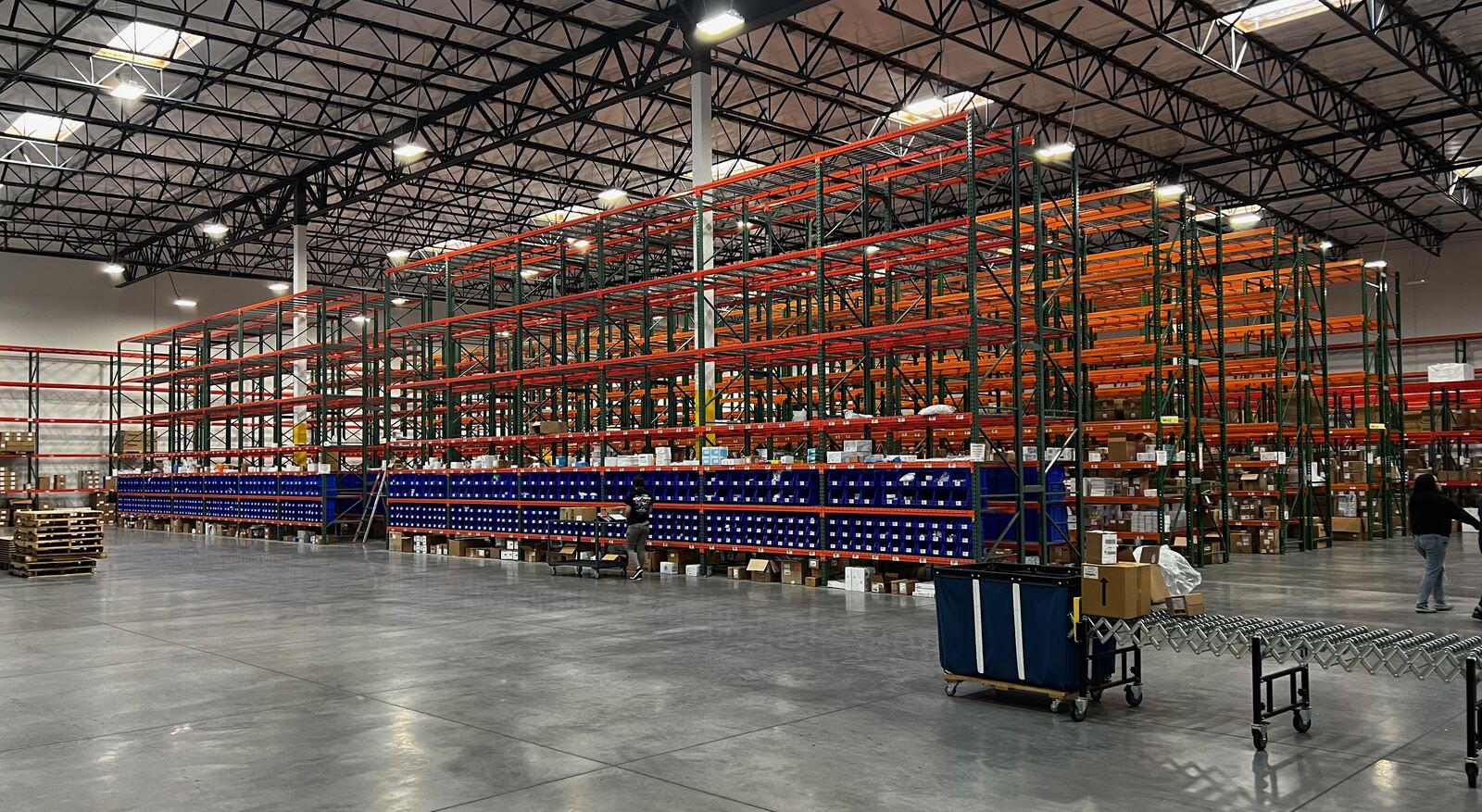
Bin naming is the cheapest infrastructure decision in a warehouse and one of the most expensive to change later. Most operations get it approximately right on the first pass, then spend years working around the parts they got wrong.
Here is what holds up.
What a good location code has to do
A location code has four jobs. Any scheme that fails one of them will cause problems.
- Be unique. Obvious, but duplicate codes across zones or buildings are common after an expansion.
- Tell a human where to walk. A picker should be able to read the code and know the direction to move without consulting a map.
- Sort correctly. Codes are sorted constantly to build pick paths. If they sort wrong, travel time increases on every order.
- Scan reliably. The code has to survive being printed small, mounted on a rack, and read at an angle in poor lighting.
Anatomy of a code that works
The widely used pattern is a hierarchy from largest to smallest:
ZONE - AISLE - BAY - LEVEL - POSITION
For example, A-01-04-C-2 reads as zone A, aisle 01, bay 04, level C, position 2.
Most operations do not need all five segments. A single small building might use three:
A-01-04 means zone A, aisle 01, bay 04.
Start with the fewest segments that uniquely identify a pick face, and leave room to add one later. Adding a level segment to a three part code is straightforward. Reordering the hierarchy is not.
The rules that prevent pain later
Use fixed width, always zero padded. Use 01, not 1. This is the single most common mistake, and it breaks sorting the moment you pass nine aisles. Sorted as text, aisle 10 comes before aisle 2. Every pick path built on that data sends people back and forth for years.
Pad generously. If you have 8 aisles today, use two digits. If you might exceed 99, use three. The cost of an unused digit is zero. The cost of renumbering is not.
Drop ambiguous characters. Remove I, O, Q, S, Z, and the digits 1, 0, 5, 2 from any segment where confusion is possible. On a scuffed label in a dim aisle, I and 1 are the same character, as are O and 0, S and 5. Many operations use letters for zones and levels and digits everywhere else, which sidesteps most collisions.
Pick one separator and never vary it. Hyphens are the common choice. Whatever you pick, use it everywhere, including in the barcode. Mixed separators break every text match downstream.
Do not encode meaning that changes. Naming a zone FAST or naming an aisle by its current product family guarantees the label lies within a year. Encode geography, which does not move. Product velocity is an attribute of the item, not the shelf.
Number in the direction people walk. Bay numbers should ascend in the direction of normal travel down the aisle. If they ascend one way on the left and the other way on the right, pick paths will look correct on screen and be wrong on the floor.
Barcodes
A few practical points that cause real problems when missed:
- Print the human readable text under every barcode. Scanners fail. People need a fallback.
- Match the encoded value to the printed value exactly, including separators. A barcode that encodes A0104 while the label reads A-01-04 will cause mysterious mismatches during counting.
- Code 128 is the sensible default for alphanumeric location codes. It is compact and widely supported.
- Mount at a consistent height and at the pick face, not on the upright where it is ambiguous which bay it labels.
- Consider a check digit if your scanning environment is harsh. It costs one character and eliminates a category of silent misreads.
Special locations deserve a prefix
Receiving, staging, returns, quarantine, and damage areas should be visibly different from pick faces:
| Prefix | Purpose |
|---|---|
| RCV-01 | Receiving dock positions |
| STG-01 | Outbound staging |
| RTN-01 | Returns pending disposition |
| QAR-01 | Quarantine or hold |
| DMG-01 | Damaged, pending write off |
The prefix means anyone can tell at a glance whether inventory is in a sellable location. It also makes filtering trivial in reporting, which pays off constantly.
Renumbering without stopping work
If your current scheme is broken, you can fix it without a shutdown:
- Design the new scheme completely first, including special locations and growth padding.
- Build a mapping table from every old code to its new code. Keep it after the migration.
- Convert one zone at a time, during a low volume window.
- Label with both codes during transition. New code prominent, old code small underneath.
- Count the zone immediately after conversion. You are going to find inventory that was never where the system thought it was, and doing this zone by zone keeps that discovery manageable.
- Remove old labels only after a full cycle through that zone with no navigation errors reported.
The mapping table matters more than it seems. Historical data, old pick lists, and anything printed before the migration will reference old codes for years.
A reasonable default
If you are starting fresh and want a scheme that will hold:
- Zones as single letters, skipping I, O, Q
- Aisles as two or three zero padded digits
- Bays as two zero padded digits, ascending in the direction of travel
- Levels as single letters from the floor up, skipping I, O, Q
- Hyphen separators throughout
- Special areas with three letter prefixes
That gives you A-01-04-C and it will still make sense after you double the building.