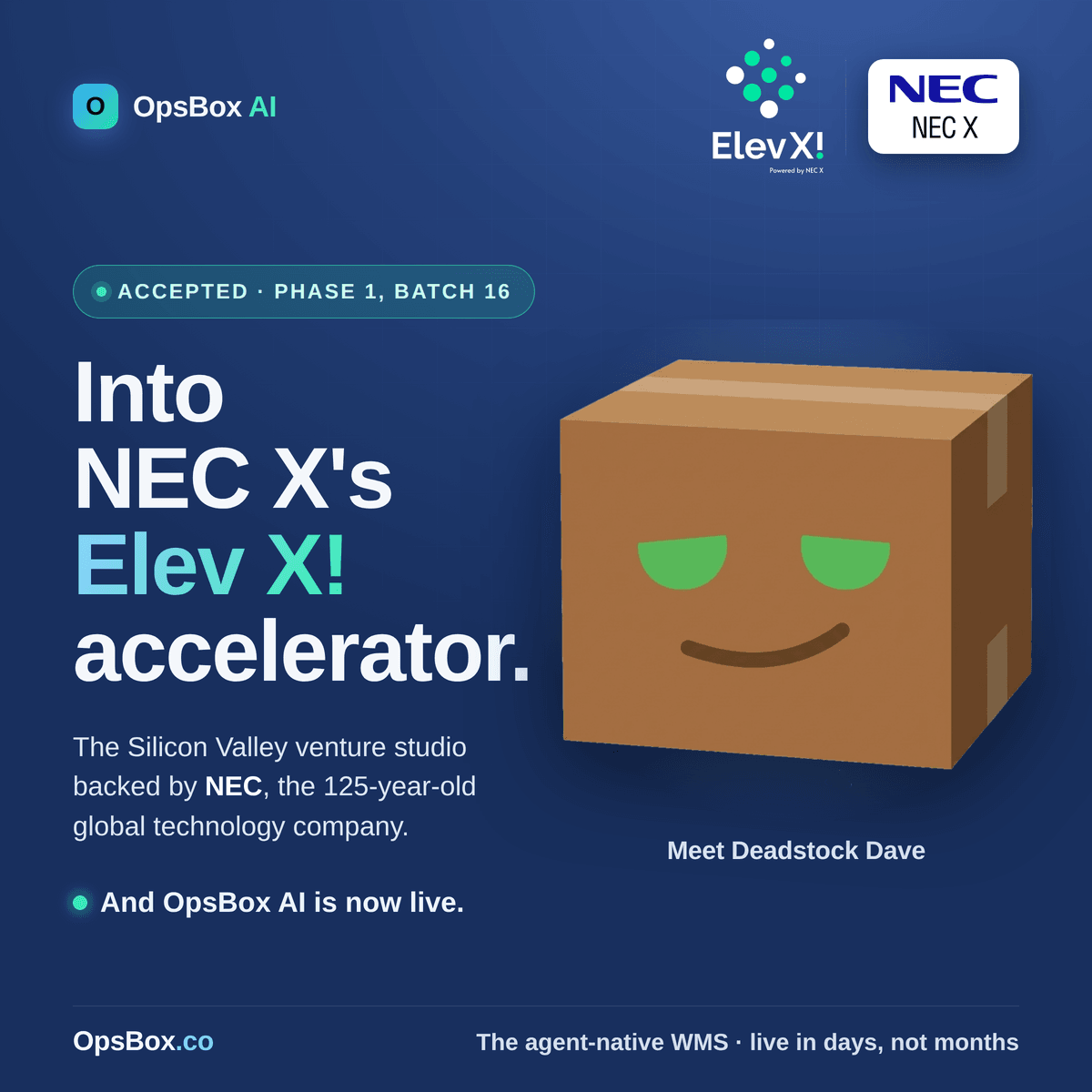
We have been accepted into ELEV-X Batch 16, the accelerator program run by NEC X.
That sentence means a lot inside the startup world and almost nothing outside it, so here is the plain version: a large corporation with a real research arm looked at what we are building, spent time pulling it apart, and decided it was worth backing. For a company selling warehouse software to operators who are rightly suspicious of new vendors, that matters more than anything we could say about ourselves.
What NEC X and ELEV-X actually are
NEC X is NEC Corporation's Silicon Valley venture studio. Its job is to take emerging technology and research coming out of NEC and turn it into companies, working with founders from outside the corporation rather than only spinning out internal teams.
ELEV-X is the accelerator it runs to do that. Companies in the program get access to NEC's technology and research, along with the usual accelerator machinery: mentorship, structured feedback, introductions, and the kind of scrutiny that surfaces problems you have been quietly avoiding.
Batch 16 means the program has been doing this for a while. That was part of the appeal. We were not interested in being the experiment.
Why we applied
Warehouse software has a trust problem, and it is deserved.
Operators have been sold expensive systems that took eighteen months to implement, required consultants for every change, and still left them exporting to a spreadsheet to find out where their inventory actually was. When a new vendor shows up promising something better, the reasonable reaction is skepticism. We hear a version of it in almost every conversation: this looks good, but who are you.
We cannot answer that with marketing copy. We can answer it by being examined by people whose job is to find the holes. That is most of why we applied.
The other reason is narrower and more technical. We are building around the idea that a warehouse manager should be able to change how their operation runs by describing it, rather than by filing a customization request and waiting a quarter. Building lists, adding rules, adjusting how work gets assigned. That idea is only interesting if it holds up under real operational load, with real edge cases, in warehouses that do not behave like the demo. NEC X has the research depth and the industrial relationships to pressure test that properly.
Here is what NEC X said after reviewing what we are building:
The insight that AI agents could serve warehouse managers through a conversational interface, allowing them to build picking lists and add rules via chat rather than requiring expensive customization, reflects a meaningful and original take on a real operational problem.
We are quoting that partly because we are proud of it, and partly because it names the specific thing we care about. Not the AI. The removal of the customization tax.
What we are hoping for
Three things, in order of how much they matter to us.
Being wrong earlier. The most expensive mistakes in software are the ones you discover after you have built on top of them. We would rather have our assumptions attacked now, by people with no reason to be polite, than find out from a customer in month nine. Every accelerator promises this. The good ones deliver it uncomfortably.
Access to harder problems. Our current thinking is shaped by small and mid-size operations, which is deliberate: that is who we serve and who is worst served today. But we want to understand where our approach breaks at larger scale, in more automated environments, and under constraints we have not encountered. NEC's research and industrial reach is the fastest route to those problems.
Credibility we did not write ourselves. A warehouse manager evaluating us is making a bet that we will still be here through their implementation. That is a fair thing to worry about and we cannot argue our way out of it. Corporate backing is not a guarantee, and we will not pretend otherwise, but it is an outside signal, and outside signals are the only ones worth anything on that question.
What does not change
We are not pivoting toward enterprise. We are not adding an implementation team you have to pay for. The thing we are building is still a warehouse system for operations that need bin-level accuracy, scanner-first picking, and counts that hold up, without a six figure quote and a consultant on retainer.
If anything, this makes us more committed to that. The gap in this market is not at the top. It is with every operation that has outgrown spreadsheets, cannot justify an enterprise WMS, and has been told those are the only two options.
That is the problem we came to solve. The accelerator is a way to solve it faster and with fewer wrong turns.
If you run a warehouse and you have opinions about what we are getting wrong, we would genuinely like to hear them. That kind of feedback has been worth more to us than anything else so far.